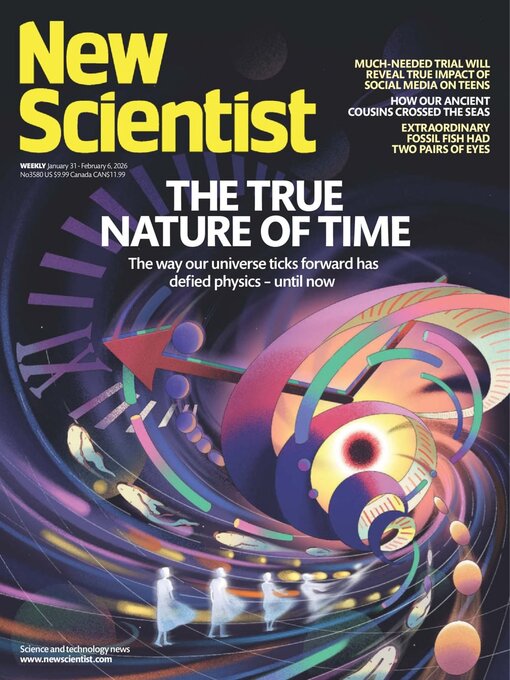
 Jan 31 2026
 Jan 24 2026
 Jan 17 2026
 Jan 10 2026
 Jan 03 2026
 Dec 27 2025
 13-26 December 2025
 Dec 06 2025
 Nov 29 2025
 Nov 22 2025
 Nov 15 2025
 Nov 08 2025
 Nov 01 2025
 Oct 25 2025
 Oct 18 2025
 Oct 11 2025
 Oct 04 2025
 Sep 27 2025
 Sep 20 2025
 Sep 13 2025
 Sep 06 2025
 Aug 30 2025
 Aug 23 2025
 Aug 16 2025
New Scientist covers the latest developments in science and technology that will impact your world. New Scientist employs and commissions the best writers in their fields from all over the world. Our editorial team provide cutting-edge news, award-winning features and reports, written in concise and clear language that puts discoveries and advances in the context of everyday life today and in the future.
Slowly does it • It would be a mistake to rush into banning social media for under-16s
New Scientist
Beached bunker is victim of erosion
Solar geoengineering comes at a cost • Plans to block sunlight would need to continue uninterrupted for centuries in order for global warming to not come back at a faster rate, finds Alec Luhn
Stick shaped by ancient humans is the oldest known wooden tool
Hybrid megapests in Brazil are a threat to crops worldwide
Does limiting social media help teens? We’re about to find out • A trial designed in partnership with young people should tell us more about how social media affects them, reports Michael Marshall
An eye-opening discovery • Extraordinary fossils of 518-million-year-old jawless fish appear to show that these animals had two pairs of eyes, discovers James Woodford
How bird retinas work without oxygen
Mars’s gravity may help control Earth’s climate
Ancient bacterium discovery rewrites origins of syphilis
Oral bacteria could hold key to obesity • Fresh evidence suggests that the oral microbiome reflects, and may contribute to, metabolic changes associated with obesity, but the full picture isn’t yet clear, finds Chris Simms
Starlink’s year of near misses • SpaceX’s mega-constellation is having to perform a huge number of manoeuvres to prevent a collision in Earth orbit, discovers Jonathan O’Callaghan
Satellites could use magnetic fields to avoid collisions
Hand stencil with claw-like fingers is the world’s oldest known rock art
Whale hunting trick is spread via social groups
How magic mushrooms got their mojo
Want to stay healthy? Get creative • From dancing to crafting, engaging in the arts is good for our health, and we’re beginning to understand how this behaviour affects our biology, reports Helen Thomson
Cross-training may be the key to a longer life
On the edge of the quantum world • An experiment has revealed quantum effects for the biggest object yet – calling into question the limits of quantum mechanics, finds Karmela Padavic-Callaghan
Ape-like hominin Paranthropus was more adaptable than we thought
Barnacle gloop could treat inflammatory bowel disease
The commodified self • Social media is driving the consumerisation of our health. But what’s hitting our screens isn’t neutral, says Deborah Cohen
Cosmology column • A very good place to start What was the most important second in the entire 13.8-billion-year history of the universe? Let’s go back to the beginning, says Leah Crane
Making waves
Rubbing along in the world • How much do you know about friction? Karmela Padavic-Callaghan discovers its overlooked role in everything from climate change to dark matter
What sickness does • A history of the effects of illness on individual lives and collective beliefs is a very mixed bag, says Peter Hoskin
New Scientist recommends
Riding a big wave • Where is physics headed? No one knows for sure, but a remarkable new book reminds us what a big idea really looks like, finds Jon Cartwright
Your letters
THE ILLUSION OF TIME • The way time ticks forward in our universe has long stumped physicists. Now, we may be close to revealing time’s true nature, finds Zack Savitsky
Stone Age seafarers • People crossed seas to make islands...